


Anthropic Investors Aren’t Just Buying a Chatbot—Here’s How the Company Behind Claude Makes Money
Anthropic Investors Aren’t Just Buying a Chatbot—Here’s How the Company Behind Claude Makes Money

Peter GrattonWed, October 28, 2026 at 9:00 AM UTC
0
Anthropic’s filing sets up the year’s second blockbuster IPO, after SpaceX.Credit: Bloomberg/ Getty ImagesWhat You -
Four-fifths of Anthropic’s revenue for the first half of 2026 came from metered usage, priced per token and by model tier.
Subscriptions, including the Claude app, made up the rest.
Nearly 12,000 customers spending $100,000 or more a year accounted for about three-quarters of 2025 revenue.
Anthropic asks investors not to treat its stock as “purely transactional.” Anyone buying in will still want a look under the hood.
The company’s seven co-founders are pitching its shares as “an opportunity to be part of something greater.” Anthropic’s IPO prospectus, filed Monday, sets up what is expected to be one of the biggest new listings of all time. (If you’re interested in getting in on Anthropic before the IPO, read this piece on Value Add, Investopedia’s Substack.)
The company has already grown into a substantial business. Its filing shows revenue of $16.3 billion in the first half of 2026, up from $1.2 billion a year earlier. Four-fifths of it came from what the company calls “pay-for-intelligence”: customers paying for tokens, a small chunk of the data a model reads and writes. The remaining revenue came from subscriptions, including for its Claude app, which the filing describes as “top-of-funnel demand generation” to pull in enterprise business.
Here’s a look inside Anthropic’s business.
Why This Matters to You
If you own an index fund that follows the Nasdaq 100, you’ll likely own Anthropic soon. Nasdaq’s fast-entry rule adds a new listing after 15 trading days if it ranks among the index’s largest companies. SpaceX entered the index just 25 days after its IPO this summer.
The Meter Behind the Money
Anthropic sells four model tiers. The top tier goes by the name “Fable” for the general public and “Mythos” for vetted customers in life sciences and security. Below that are Opus, Sonnet, and Haiku. Pricing is based on the model and how many tokens a customer burns through, a mix the filing calls the “capability-cost-speed curve.” Think of it like filling up at the gas pump: The grade sets the price per gallon and the volume determines the final cost.
Customers typically route simple tasks to cheaper, faster models and use pricier ones for more complex coding or reasoning. Revenue for tokens reached $13.1 billion in the first half; that accounted for 80% of the company’s total, down from 83% in 2025.
Subscriptions—flat monthly fees for access to the Claude app, with a cap on usage—brought in the rest, at $3.2 billion. They can also feed into token revenue: When subscribers hit their usage limit, they can upgrade their plan or buy more tokens directly. (This might recall cell-phone plans where you bought a certain amount of service for a fixed rate and then paid more for overages.)
AI agents—programs that carry out tasks on their own rather than responding one prompt at a time—run up the meter fastest. They can work for hours, sending and receiving long chains of prompts and results, each one metered. The filing’s own example: In the third quarter, Claude Enterprise customers who didn’t use Claude Code, the firm’s app for coding agents, spent an average of less than $75 a month. The heaviest Claude Code users, the top 5%, spent about 20 times that.
Advertisement
That makes Anthropic more reliant on relatively few big clients. Nearly 12,000 customers spent $100,000 or more as of the third quarter, up from 950 the year before. This group produced more than three-quarters of its revenue. The top five customers accounted for about 25% of revenue. About 40 million smaller individual customers, including subscribers, made up the rest.
Nearly half of Anthropic’s business is sold through the cloud marketplaces of Amazon Web Services (AMZN), Alphabet’s (GOOG) Google Cloud, and Microsoft’s (MSFT) Azure. These cloud services act as sales channels for Claude and take a cut from Anthropic’s fees.
All three firms are also investors, suppliers of compute, and competitors, a tangle the filing says could create “conflicts of interest that are difficult to fully anticipate or mitigate.”
The Big Bill for Compute
Investors have been pricing Anthropic on revenue because, until this filing, everything below it on the income statement was a loss. “Put simply, desperation drives you up the income statement until you find a positive number,” New York University finance professor Aswath Damodaran wrote four days before the prospectus came out.
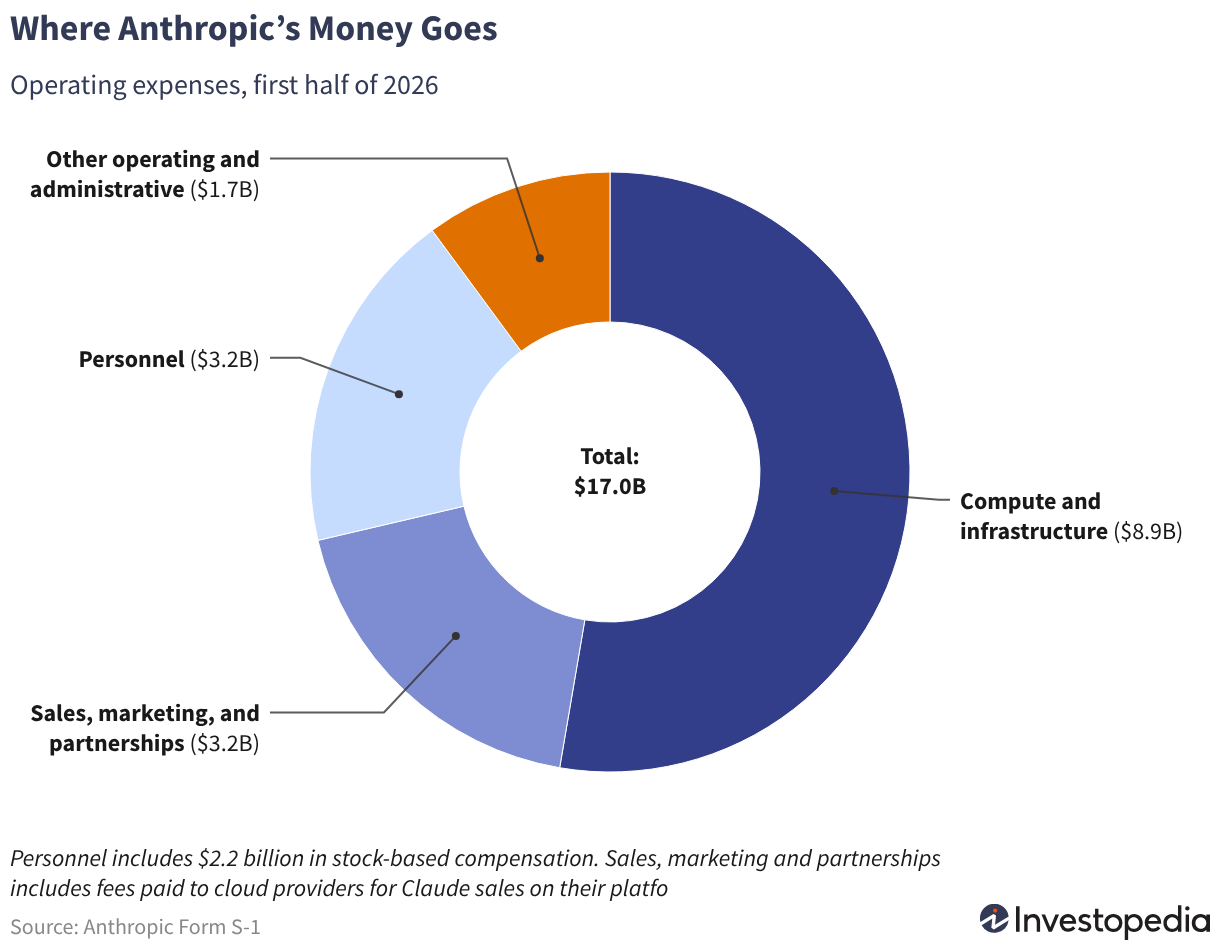
Compute costs, which cover the chips and data centers that train and run Anthropic’s models, are Anthropic’s biggest bill, by far. The company spent $8.9 billion on compute and infrastructure in the first half of 2026, or 55% of revenue. The year before it spent about twice as much as it took in.
Personnel costs totaled $3.2 billion, with $2.2 billion of it in stock awards. Sales, marketing, and partnerships, including fees paid to the three big cloud providers, took about the same amount.
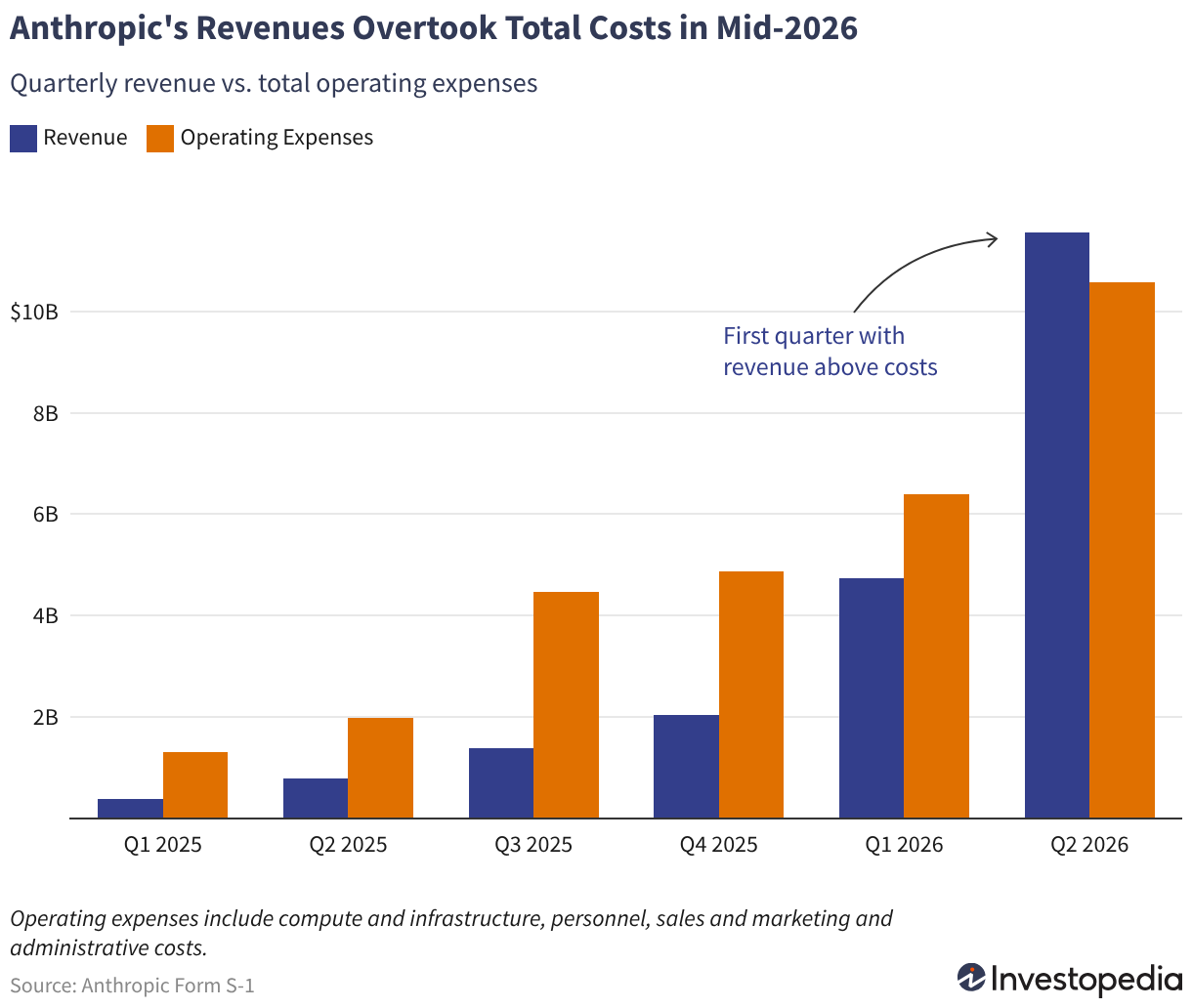
The filing also shows Anthropic’s first profitable quarter on an operating basis. The company earned $974 million in operating income in the second quarter, an 8% margin, after a $1.7 billion operating loss in the first. The net loss of $80.7 billion for the first half of 2026 comes mostly from an accounting change: More than $72 billion of it is a non-cash charge for revaluing convertible notes as the company’s valuation rose.
Bigger bills are ahead. Since January, the company has inked compute deals with minimum future payments of about $417 billion on terms of up to 20 years. It expects another $125 billion to $150 billion for chips due between 2028 and 2031. Its biggest commitment involves Google, at least $115 billion through July 2033, owed “regardless of actual usage.”
Summary List
Go beyond the day’s market moves with Investopedia’s Value Add, where you’ll find sharp analysis, investing ideas, and practical guidance on what today’s biggest financial stories could mean for your money. Explore Value Add and subscribe on Substack.
on Investopedia
Source: “AOL Money”
